

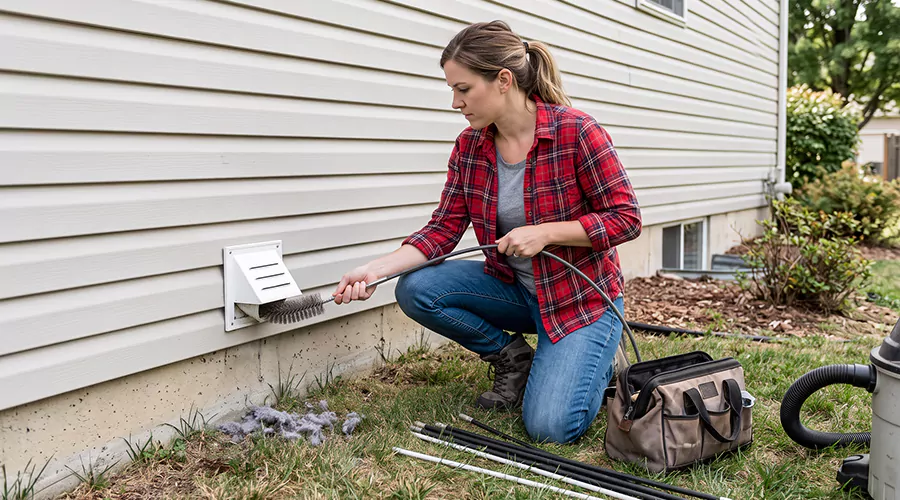
Dryer vent cleaning can cost approximately $6 to $11 per linear foot in some U.S. markets, but most residential contractors charge a flat rate rather than using a universal per-foot price. In 2026, standard dryer vent cleaning commonly costs $80 to $185 per job, while roof vent cleaning typically ranges from $150 to $250. The final price depends on the length and accessibility of the exhaust duct, along with the amount of accumulated lint.
Dryer vents carry warm, moisture-laden air from a clothes dryer to an outdoor termination. During normal operation, fine fabric fibers pass through the lint filter and collect along the exhaust passage. Over time, these deposits can restrict airflow and increase drying times. A longer duct provides more surface area where lint can accumulate, particularly when the route includes several bends.
However, duct length alone does not determine the cleaning cost. A short vent containing a severe blockage may require more work than a longer straight duct with light lint accumulation. Understanding how contractors calculate prices helps homeowners compare estimates and avoid confusing a per-foot allowance with the total service charge.
What Is the Average Dryer Vent Cleaning Cost per Foot in 2026?
There is no established nationwide price for dryer vent cleaning per linear foot. Most professional services quote a complete cleaning based on the exhaust configuration and access conditions. Some contractors use duct length to calculate additional labor or to estimate the cost of unusually long installations.
As one published local example, 2026 dryer vent cleaning estimates for Chicago use approximately $6 to $11 per linear foot. This figure should not be treated as a fixed national rate because local labor costs and company pricing methods vary. A contractor may also charge a minimum service fee regardless of the length of the exhaust.
The following table illustrates what that specific per-foot pricing range produces at different duct lengths.
| Dryer Vent Length | Example Length-Based Cost at 6–11 per Foot |
|---|---|
| 5 feet | 30–55 |
| 10 feet | 60–110 |
| 15 feet | 90–165 |
| 20 feet | 120–220 |
| 25 feet | 150–275 |
| 30 feet | 180–330 |
| 35 feet | 210–385 |
These figures illustrate a length-based pricing model, not guaranteed final invoices. A cleaning company may have a minimum charge or additional fees for difficult access. Conversely, another contractor may include the entire duct in one flat price without calculating each foot separately.
The most useful comparison is the total quoted price for cleaning the complete exhaust system. That includes the permanent duct and the applicable outdoor termination, along with any specified work on the transition duct behind the dryer.
Why Do Most Dryer Vent Cleaners Charge a Flat Rate?
Flat-rate pricing is common because cleaning a dryer vent involves tasks that are not directly proportional to duct length. A technician must access the appliance, inspect the connections and use cleaning equipment regardless of whether the duct measures eight feet or fifteen feet. Travel and setup time also contribute to the total cost.
For example, a short vent through an exterior wall may be relatively simple to clean. However, the technician still needs to remove lint, check the termination and confirm that the exhaust remains connected correctly. These steps create a minimum amount of work even when the duct is only a few feet long.
Longer ducts can justify additional charges because the cleaner may need extension equipment or more time to reach the outlet. The number of turns can also change the difficulty. As a result, a flat rate for a typical installation may be combined with additional charges for unusual length or access requirements.
Flat-Rate Pricing
A flat-rate quote covers a defined cleaning service for one dryer exhaust system. It may include cleaning from the appliance connection to the outdoor termination and checking the exterior damper. The contractor should explain any limitations before work begins.
A flat price is convenient because the homeowner knows the expected charge in advance. However, it should be clear whether heavy obstructions or roof access fall outside the standard service. Two flat-rate quotes may represent different levels of cleaning.
Per-Foot Pricing
A per-foot quote uses the length of the duct to calculate all or part of the cleaning price. This model may be used when the exhaust route is unusually long or when a contractor offers cleaning across many different duct configurations. The rate should be explained alongside any minimum fee.
Ask whether the charge applies to the full duct length or only the portion beyond a standard allowance. This distinction matters because a company might advertise a base price that already includes a typical vent. Paying a length charge on top of that base may substantially change the final total.
Hourly Pricing
Some contractors charge by the hour when access is complicated or the blockage cannot be assessed accurately in advance. This approach can be appropriate for difficult cleaning, but the estimate should describe the expected work. The homeowner should understand what circumstances could extend the service time.
An hourly rate does not necessarily produce a higher total than flat-rate pricing. A straightforward job may be completed quickly, while a badly obstructed system can take considerably longer. Comparing the total expected price remains more meaningful than comparing labor rates alone.
How Does Dryer Vent Length Affect Cleaning Cost?
A longer dryer vent can increase cleaning costs because the technician must reach and clear a greater distance. Long passages may also contain additional fittings that complicate brushing and vacuuming. However, length does not determine whether the duct is safe or whether it contains a significant blockage.
A straight twenty-foot metal duct may be easier to clean than a shorter duct containing several tight elbows. Lint often accumulates around changes in direction where the airflow pattern changes. The condition of the passage can therefore be as important as its total length.
Short Dryer Vents
A short vent may travel directly from the dryer through an exterior wall. This arrangement often provides access near both ends of the exhaust and may require relatively little extension equipment. When the duct is sound and only lightly coated with lint, cleaning can be straightforward.
However, a short duct can still become clogged if the transition hose is crushed or the exterior damper is blocked. Cleaning should address the actual restriction rather than assume that a short vent is automatically clear.
Medium-Length Dryer Vents
Medium-length installations may pass through a laundry room wall or ceiling before reaching the outdoors. These ducts can contain one or more elbows that increase cleaning difficulty. The technician may need to approach the passage from different access points to remove debris.
The price may remain within a standard service range when the duct is accessible and in good condition. A difficult bend or heavy accumulation can increase the work even if the measured length is not unusual.
Long Dryer Vents
Long exhaust routes may run through several concealed spaces before reaching the termination. These installations are sometimes found in apartments and homes with interior laundry rooms. Cleaning can require extended brushes, inspection equipment or access to a distant outdoor outlet.
A very long duct may also need an installation assessment. The permitted length depends on the dryer manufacturer's requirements and applicable building code. Cleaning a duct does not correct a vent configuration that exceeds those requirements.
How Do You Measure Dryer Vent Length?
Dryer vent length is measured along the route taken by the exhaust duct, rather than as a straight line between the dryer and the outside wall. A duct that changes direction several times may be significantly longer than the direct distance between its endpoints. The full route matters when determining cleaning difficulty and checking installation requirements.
Homeowners can estimate an accessible vent length without opening finished walls. Start by identifying where the dryer connects to the permanent duct and where the exhaust terminates outdoors. Measure visible straight sections and record the locations of known bends.
Follow these steps when gathering information for a cleaning quote:
- Identify the dryer exhaust connection behind the appliance.
- Locate the outdoor exhaust termination.
- Measure safely accessible straight duct sections.
- Identify any visible changes in direction.
- Check whether the route passes through a ceiling or upper floor.
- Review installation documents if the concealed route is uncertain.
- Tell the cleaner which sections cannot be measured directly.
- Request confirmation of the duct length during inspection if needed.
Do not cut into walls or remove building materials simply to measure the vent. Concealed ducts may be difficult to trace, and unnecessary openings can create new problems. A qualified technician may use inspection equipment or building plans when an accurate length is needed.
Actual Length Versus Equivalent Length
Actual length is the measured distance along the duct. Equivalent length is a design calculation that accounts for additional resistance caused by elbows and fittings. These are related but different measurements.
For example, a twenty-foot duct with several bends can create more airflow resistance than a straight twenty-foot duct. Building codes and dryer manufacturers may apply deductions or equivalent lengths when determining allowable exhaust configurations. Those design calculations do not automatically establish how a cleaning company should charge.
Before accepting a per-foot quote, ask whether the price uses the physical duct length or another defined measurement. The method should be clear enough for the final invoice to be checked.
How Do Bends and Elbows Change Dryer Vent Cleaning Prices?
Elbows can make cleaning more difficult because brushes must travel around changes in direction. Lint may accumulate where the airflow turns or where a fitting creates a small obstruction. A technician may need different equipment or additional access to reach these deposits.
A short duct with several sharp bends can therefore require more work than a longer straight passage. This is why some contractors inspect the layout before providing a final price. Charging only by the foot may not reflect the actual effort involved.
The number of bends also matters for dryer performance. Excessive resistance can slow exhaust airflow even after the vent has been cleaned. If slow drying continues despite a clear passage, the duct configuration may require further evaluation.
How Much Does Dryer Vent Cleaning Cost by Location?
Location affects cleaning cost because exterior terminations have different access requirements. Ground-level outlets are generally easier to reach than second-floor or rooftop terminations. A roof vent may require specialized access even when the duct length is relatively short.
| Dryer Vent Location | Typical 2026 U.S. Cleaning Cost |
|---|---|
| Basement or first-floor wall vent | 80–150 |
| Second-floor wall vent | 110–185 |
| Roof dryer vent | 150–250 |
| Standard residential vent, mixed locations | 80–185 |
| Difficult concealed exhaust | Site-specific estimate |
These prices are complete-service benchmarks rather than per-foot rates. A roof cleaning price may include additional access costs that are not reflected in the duct's length. Similarly, a basement installation can become expensive when the route is long and difficult to reach.
A contractor should explain whether exterior access is included. A quote covering only the connection behind the dryer is not equivalent to cleaning and checking the complete exhaust path.
Does Heavy Lint Buildup Increase the Price per Foot?
Heavy lint buildup can increase the total cleaning price because more time may be required to remove the obstruction. However, the extra work is usually related to the severity and location of the blockage rather than a fixed number of feet. A dense lint plug at one elbow may be more difficult than light deposits spread along a longer duct.
Some contractors include normal lint removal within their standard fee. Others may charge additional labor for major obstructions or repeated cleaning passes. The proposed extra charge should be explained before the work continues.
Bird nests or other foreign materials can also create obstructions. These are different from routine lint deposits and may require separate removal or pest-related services. If the vent is damaged or an animal is present, the technician should identify the condition rather than force a brush through it.
What Additional Costs Should You Expect?
Additional charges may apply when the service identifies a problem beyond ordinary lint cleaning. A damaged transition duct or exterior hood may require replacement. The cleaning company should identify these tasks separately so homeowners know which costs are necessary for clearing the vent.
| Additional Work | Typical 2026 U.S. Cost |
|---|---|
| Dryer vent inspection | 30–60 |
| Cleaning with bird nest removal | 120–250 for some projects |
| New dryer vent installation or rerouting | 200–800 |
| Replacement of an accessible damaged vent | 100–300 |
| DIY dryer vent cleaning kit | 15–50 |
These ranges describe different services and should not be automatically added together. A cleaning visit may already include an inspection, while vent replacement is a separate project. The estimate should state what is included and identify any optional work.
Unnecessary chemical treatments should not be confused with lint removal. A dryer exhaust needs physical cleaning when lint has accumulated. Applying chemicals does not remove a blockage or replace mechanical repair of damaged material.
Is Cleaning a Long Dryer Vent More Expensive Than Replacing It?
Cleaning is usually less expensive when the duct is structurally sound and only contains lint deposits. Replacement becomes more appropriate when the material is damaged or the route is unsuitable for the dryer. The decision depends on the condition of the system rather than its length alone.
A long, sound metal duct may need periodic professional cleaning but no replacement. A shorter duct made from unsuitable plastic material should be corrected even if it appears relatively clean. Similarly, a crushed transition hose may require replacement rather than repeated lint removal.
When a vent repeatedly becomes clogged shortly after cleaning, the layout deserves investigation. Sharp bends and compressed sections can create persistent airflow restrictions. Correcting the cause may provide better long-term value than paying for increasingly frequent cleaning.
Can You Save Money by Cleaning a Dryer Vent Yourself?
DIY dryer vent cleaning kits typically cost $15 to $50. For a short, sound and safely accessible metal exhaust, a compatible brush and vacuum may be practical. However, the lower initial cost does not mean household equipment is suitable for every duct route.
Long concealed passages can be difficult to clean completely. Brush extensions may separate or become stuck around bends if used incorrectly. A roof termination also introduces fall hazards that should not be accepted merely to avoid a service charge.
Gas dryer connections require additional caution. If moving the appliance would disturb or strain its gas supply, qualified service is the safer option. The exhaust should not be cleaned in a way that creates an appliance or fuel-line hazard.
What Should Be Included in a Dryer Vent Cleaning Quote?
A useful quote should describe the entire exhaust route and the services being performed. This is especially important when pricing is based on duct length because the measured distance may not explain all access requirements. A complete estimate prevents unexpected charges after the technician begins.
Ask the cleaning company to clarify the following:
- Is the price flat-rate or based on linear feet?
- Does the rate include a minimum service charge?
- How is the exhaust length measured?
- Are elbows and difficult bends included?
- Will the transition duct behind the dryer be cleaned?
- Will the exterior termination be checked?
- Does the price include access to a second-floor or roof outlet?
- What additional charges apply for a major obstruction?
- Will damaged components be quoted separately?
- How will the technician check airflow after cleaning?
These questions help distinguish a length-based estimate from a complete service quote. A lower advertised price may not cover the full exhaust. Comparing the actual scope of work is more useful than focusing on a per-foot rate alone.
How Often Should Long Dryer Vents Be Cleaned?
A full dryer vent cleaning approximately once a year is a reasonable starting point for many households. Longer exhaust routes may require more frequent attention because additional bends and restricted sections can contribute to buildup. The actual maintenance interval should reflect dryer use and the condition of the vent.
The U.S. Fire Administration advises homeowners to maintain dryer vents and remove lint from the filter before or after every load. These tasks address different parts of the exhaust system. A clean filter reduces the amount of material entering the duct but does not eliminate the need for periodic vent cleaning.
If drying times increase or the appliance becomes unusually hot, do not wait until the next scheduled cleaning. The exhaust should be inspected for restrictions. A burning smell requires stopping dryer use until the problem has been assessed.
Conclusion
Dryer vent cleaning does not have one standard nationwide cost per foot. Some local pricing examples use approximately $6 to $11 per linear foot, but most residential projects are quoted as a complete service. Standard cleaning commonly costs $80 to $185 in 2026, with higher prices for roof vents and complicated routes. Duct length, bends and access conditions all affect the final amount. Before booking, request a quote that clearly identifies the complete exhaust path and any additional charges.